
Packrafting is a fascinating little niche sport, and it tends to attract great people – folks with an intrepid streak who see themselves as explorers. There are two main pathways into it: through backpacking and general outdoorsiness, or through the river community. From what I’ve seen, most packrafters are hikers first and boaters second. River people, those who grew up on the water, are usually rafters or kayakers. That’s changing as more cross over, but the patterns remain: rafters and IK folks rarely go ultralight, while kayakers are usually chasing performance. Broad strokes, but they fit my experience.
I had a little exposure as a kid, canoeing with my dad, a San Juan raft trip at 13, but we weren’t a boating family. I found packrafting later, through the ultralight gear obsession that took hold in my thirties when I finally had a budget to build a real kit. That rabbit hole led me to the Backpacking Light forums, where I stumbled on the packraft section. At first I figured I’d just pick up a Scout to fish alpine lakes I was already hiking to.
Then I went to the first Packraft Soirée on the American River. I rented an IK and ran two Class III sections with absolutely no idea what I was doing. I swam, got rescued by friendly boaters, and was instantly hooked. I bought an Alpacka Classic, figuring it was the sweet spot: light enough to carry, capable enough for Class III.
Over the next five years, I learned a lot. The biggest lesson: just how much I do not know.
Stages of Learning
This framework was taught to me by an excellent kayak instructor, Silas Beaver:
- Unconscious incompetence
You don’t know what you don’t know. Gaps are invisible, and you may not even see the value in learning the skill. In paddling, this looks like swimming without knowing why, staring at a rapid without tools to read it, or carrying bad habits you don’t realize you have.
- Unconscious incompetence
- Conscious incompetence
The blinders are off. You can see what you can’t yet do. Your ferry angles are sloppy, your brace is late—but at least now you recognize it. When you swim, you know why. You can name the missing skills or bad habits and start to see how to fix them.
- Conscious incompetence
- Conscious competence
The pieces begin to come together. You can execute strokes and maneuvers with focus, often step by step. You scout a rapid, make a plan, and concentrate hard to pull it off. A lapse in focus still often means a blown line or another swim.
- Conscious competence
- Unconscious competence
After enough practice, skills become second nature. Strokes blend without conscious thought. You read water in motion, adjusting midline without overthinking. At this stage you paddle fluidly, and you can start passing knowledge on to others.
- Unconscious competence
This applies not just to your overall ability as a boater, but to every micro-skill, from eddy turns to strokes to reading water.
Kayaks vs. Packrafts: Different Learning Curves
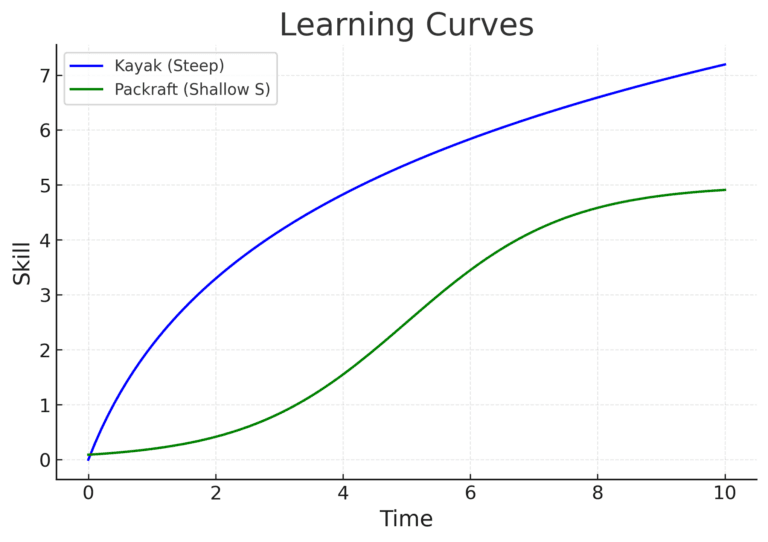
- Steep curve – Kayaking front-loads mechanics. Flow states are scarce and it’s frustrating, but you log huge gains in edge discipline (engage/disengage edges on purpose) and blade precision (draws, pries, low/high braces). Coaching usually starts day one, so the foundation gets poured early.
- Shallow curve – Packrafting front-loads access. You can have fun sooner and run bigger water earlier, but you don’t learn to use. your hips at all, because the boat has no edges, or much softer ones. Progress feels fast; skill depth lags.
People throw around “learning curve” casually, but it actually has some shape to it. Some skills are step-function: you grind at the basics, stuck on a plateau, until something clicks and suddenly you can do a whole new class of moves. Other skills are more continuous: small bits of progress stack up smoothly without those hard walls. Think of climbing versus running—one jumps in leaps, the other adds mileage steadily.
In paddling, those curve shapes really matter. Kayaking has one of the steepest. The boat punishes bad technique. Until you have a roll and the fundamentals dialed, you are constantly upside down and swimming. Most adult learners grind through a pool roll and a season of Class II before Class III feels like fun instead of survival. That early wall is brutal, but once you break through, you’re standing on solid ground. A kayaker in Class III has genuine skill, not just nerve.
Packrafting (and IKs) flip the picture. The craft forgives sloppy technique. You can blunder into Class III on your first weekend and survive, often looking more advanced than a kayaker with the same water time. But the wall comes later, and it is higher: Class IV punishes you, and it’s not longer chill to just be falling out of your boat and self rescuing when the rapids come one after the other and the swims are dangerous. Every single advanced packrafter I have paddled with, other than one, has spent time in a hardshell.
Picture twins, Larry and Kyle. Both boat three seasons, about the same number of days each year. Larry in a kayak, Kyle in a packraft. On the surface, Kyle looks ahead—he’s been running Class III the whole time, while Larry is only just getting comfortable there. But swap boats, and the illusion cracks. Larry can jump in Kyle’s packraft and run everything Kyle runs, probably more. Kyle in Larry’s kayak might not make it cleanly down Class I. That’s the curve difference: the packraft lets you get into big water early, but it doesn’t force the same foundation. The kayak is punishing at first, but the skills transfer everywhere.
That mismatch explains some of the tension on rivers. Kayakers watch packrafters yard-saling through rapids, wondering how they skipped the dues. Packrafters wonder why they stall out when the rivers get serious..
Why Packrafters Should Hardshell
If your goal is Class III and IV, the quickest path isn’t more times flipping your packraft—it’s time in a hardshell kayak.
Here’s why: a kayak exaggerates every mistake. The hull is narrower, rounder, and much less forgiving than a packraft. That means you can’t get away with sloppy habits:
Edges matter.
Every boat has edges—the transition where the flat bottom curves into the side. What makes the kayak such a good teacher is that you feel instantly when the current grabs you. Sometimes you hold a clean, flat hull through swirly water, sometimes you tilt to let the current slip under—either way, your hips can’t go passive. The kayak forces you to anticipate what the river is about to do and engage your body before it happens. That habit—reading the water, bracing with your core, adjusting tilt on purpose—translates straight back to a packraft. Suddenly ferries are solid and eddy turns stick instead of washing out.Strokes matter.
In a packraft, you can rely on a forward stroke and a brace and muddle through most rapids. In a kayak, that toolbox is too small. You have to learn rudders to steer mid-rapid, draws to pull the bow sideways, braces that actually keep you upright, and the timing of a boof stroke to clear a ledge. None of this is optional—the kayak demands it. The bonus is that once you have those strokes, your packraft suddenly feels sharper and more precise, like upgrading from blunt scissors to a scalpel.Feedback is immediate.
A packraft gives you soft landings—you hit a hole or wave wrong and it shrugs it off. A kayak punishes the same mistake with a flip. That sharp feedback accelerates learning. You can’t kid yourself about what worked and what didn’t.Instruction is richer.
The kayak world has decades of teaching culture, with progressions built around edges, strokes, and boat control. Packraft instruction is catching up, but it mostly borrows from kayaking anyway. If you want the deepest well of coaching, that’s where it is.
The payoff: after a season in a kayak, you’ll return to your packraft with new instincts. Your ferries won’t slide, your eddy turns will lock in, your braces will actually keep you upright. The kayak makes you earn it, but the skills don’t stay in the kayak—they come with you.